I would like to share with you the following link to a website which has helped me out a lot in grandpa's WWII research.
http://www.fatherswar.com/8thinfdiv/
It's maintained by a guy named Jonathan Gawne, who wrote a book I read entitled: Finding Your Father's War. His father was also in the 8th Infantry Division, and I believe in the 28th Regiment! Anyway this book is chock full of info on how the GI's lived and fought in the United states Army in the 1940's. I'd almost recommend it as a "bible" for WWII reenactors.
It contains color photos, charts and diagrams that explain the organization of divisions, battalions, regiments and companies in plain and easy to understand english. It also contains valuable information on how to go to the NARA research center and do your own investigative work.
I have personally corresponded with Mr. Gawne, and have joined an online E-mail webring on which historians, researchers and WWII buffs, and a handful of actual 8th Div. veterans actually post their insights and findings into this little-known army group and its accomplishments.
In fact, Mr Gawne has requested permission to reproduce some of Mel's color slides of boot camp and Western Europe in his newest book, the revised edition of Finding Father's War. I am so excited and can't wait to see my grandfather given the credit he always deserved!
Sunday, February 2, 2014

Wednesday, January 29, 2014
Following the Golden Arrow Trailer #1
This looks like a very promising documentary. I have contributed some donations to it, and it's my sincere hope that the accomplishments of the Golden Arrows, the Pathfinders or the "Forgotten Division" will come to light. Best of luck, fellas!
Thursday, December 5, 2013
A Veteran's Testimony
This is the closest possible thing to an eyewitness account of the war as my grandpa saw it. This man was born the same year as Mel (1919) and would have been 88 years old at the time of the interview. I tried to search for this veteran so I could correspond with him or possibly meet him, but he died a few months later. The video this text record was transcribed from has also since been deleted.
Arthur C. Neriani
Enlisted 1940, Honorably discharged 1945
HQ Company, 13th Infantry Regiment, 8th Infantry Division
Interview conducted by Matthew Kwapien for oral veterans history project. Arthur C. Neriani enlisted in the National Guard in December of 1940. Soon after, in February of 1941, the Guard was federalized and he was sent to Camp Blanding, FL for basic training. After basic training he was sent to Officer Candidate School, and then became part of the 8th infantry division in Fort Leavenworth, KS. From there the 8th infantry division was shipped to Northern Ireland to await their orders. Twenty eight days after the D-day invasion, the soldiers were sent to Normandy to replace the 82nd airborne division. Their mission was to travel up the Brittany peninsula, and establish a port for incoming Allied supplies. From there the soldiers travelled into Germany, where they fought in the Battle of Hürtgen Forest, a battle that had 33, 000 casualties, but has been largely overlooked. Neriani describes in great detail what he and the soldiers under his command endured during the very long, cold battle. The 8th infantry division was also responsible for the liberation of the Wobbelin concentration camp, which is just outside of Ludwigslust, Germany. After the fighting in Europe ended, the soldiers were sent back to the United States in order to train for the Battle of Japan, and the Pacific theatre of operations, but the war was declared over before they were sent. Neriani was discharged in Mississippi in late 1945, and he returned to Connecticut where he joined the Avon VFW and was the first commander of the post.
Arthur C. Neriani
Enlisted 1940, Honorably discharged 1945
HQ Company, 13th Infantry Regiment, 8th Infantry Division
Interview conducted by Matthew Kwapien for oral veterans history project. Arthur C. Neriani enlisted in the National Guard in December of 1940. Soon after, in February of 1941, the Guard was federalized and he was sent to Camp Blanding, FL for basic training. After basic training he was sent to Officer Candidate School, and then became part of the 8th infantry division in Fort Leavenworth, KS. From there the 8th infantry division was shipped to Northern Ireland to await their orders. Twenty eight days after the D-day invasion, the soldiers were sent to Normandy to replace the 82nd airborne division. Their mission was to travel up the Brittany peninsula, and establish a port for incoming Allied supplies. From there the soldiers travelled into Germany, where they fought in the Battle of Hürtgen Forest, a battle that had 33, 000 casualties, but has been largely overlooked. Neriani describes in great detail what he and the soldiers under his command endured during the very long, cold battle. The 8th infantry division was also responsible for the liberation of the Wobbelin concentration camp, which is just outside of Ludwigslust, Germany. After the fighting in Europe ended, the soldiers were sent back to the United States in order to train for the Battle of Japan, and the Pacific theatre of operations, but the war was declared over before they were sent. Neriani was discharged in Mississippi in late 1945, and he returned to Connecticut where he joined the Avon VFW and was the first commander of the post.
Wednesday, September 11, 2013
Following the Golden Arrow
Ben Atkinson, an independent filmmaker working with a fledgling producer and composer, is raising money to produce a documentary about the 8th Infantry Division in the European Theater during World War II. Here's a short video about it as well as the link to the project kickstarter website:
http://www.kickstarter.com/projects/schifflifilms/following-the-golden-arrow?ref=card
The 8th ID "The Golden Arrows" are an untold story in the chapters of history. Some Army units (like the 101st and 82nd Airborne) had much better PR than others and so their story made it into the history books while others with no less interesting stories did not. Personally, being the grandson of a silent veteran who served in this division, I hope the project will give me a better understanding of what he experienced during a time America will never forget.
http://www.kickstarter.com/projects/schifflifilms/following-the-golden-arrow?ref=card
The 8th ID "The Golden Arrows" are an untold story in the chapters of history. Some Army units (like the 101st and 82nd Airborne) had much better PR than others and so their story made it into the history books while others with no less interesting stories did not. Personally, being the grandson of a silent veteran who served in this division, I hope the project will give me a better understanding of what he experienced during a time America will never forget.
Thursday, June 6, 2013
Reading WW2 Weekend
 |
Here's lookin' at you, Grandpa! |
Go here for more info if you'd like to attend this event in the future: Mid-Atlantic Air Museum
This is one of the best videos from last year's air show:
Monday, June 3, 2013
More interesting photos from basic training
There are over a hundred undeveloped slides in a small cardboard box
among Mel's possessions; I have digitized all of them. While none of these are dated, they are most likely 1941-'42, as
he was in the desert by '43. None of the people in the slides are
identifiable, but they are certainly his buddies. I will post some of
the interesting ones a few at a time from now on...
The incredible thing is not what is going on in these pictures, as every soldier in boot camp did mundane things like this every day. But rather it is the fact that my grandfather was able to capture these images, and give us an impression of what Army camp life was like during the 1940's.
 | ||||
Guarding a drinking water reservoir. Guard duty was a tedious but necessary part of being a soldier, as base security was maintained by the men who lived in it. It would be part of routine "fatigue detail," what the officers liked to call these duties because they made one fatigued. A chore to some, a happy and easy job for others, being posted as a sentry also taught the men discipline and how to be vigilant.
|


 |
Some men looking at an odd anachronism within a WWII camp...a Civil War artillery piece. This was identified by a reenactor friend as a '3-inch ordnance rifle'. The only place where this would conceivably be is at Fort Jackson, South Carolina, which would make the year 1941. |
 |
| The soldiers ate their meals with soup or rice served from old tin milk cans. |
 | ||
| A friend on 'KP duty' washing his mess kit after a meal. As every Boy Scout knows, one bucket is for hot sterilization with soap and the other bucket is for a cold rinse. |
 |
It was clear that everyone knew he had a camera, as some of these pictures appear to be staged.
"R&R" time in camp for some consisted of playing team sports, like basketball, rugby and baseball. I find the action poses entertaining. |
 |
| There was also some cheap forms of entertainment in camp. The 8th Division had its own movie theater where you could go to watch newsreels or some popular "flicks," usually by request. This was when a day at the movies cost you a couple of nickels. |
 |
| A picture of an unidentified man shaving outside his company tent. |
 |
| Eating watermelon. Now why were soldiers eating watermelon, and why did Mel take a picture?
Summers in South Carolina tend to be hot and humid, and veteran Arthur Neriani of the 13th Infantry Regiment, 8th Division, attests that one day after a long march, the men came across a fruit merchant who wandered into camp and sold them fresh watermelons, much to the pleasure of the hot and tired men. While this photo has very little significance, I find it interesting that this distant memory of an old GI was confirmed with my grandfather's photographs.
|
The incredible thing is not what is going on in these pictures, as every soldier in boot camp did mundane things like this every day. But rather it is the fact that my grandfather was able to capture these images, and give us an impression of what Army camp life was like during the 1940's.
Saturday, June 1, 2013
1942 - Mel promoted to Sergeant, Camp Forrest Tennessee Maneuvers
 |
| Mel earned his Sergeant stripes on August 7, 1942. |
 |
| Some time that year he visited home and got another photo looking sharp in his dress uniform. Interestingly, he's still wearing the brown leather 'garrison belt' that was outdated by this time (No longer required per regulations after 1941) This, and the bare trees behind him, leads me to believe this photo was taken sometime in early April or late March of '42. |
 |
| Aunt Marilyn is trying on his Class A visor cap. |
"1942 – The 8th Division was ordered to patrol the Atlantic coast. For six weeks during the winter of 1942, units of the division ranged along the eastern shores of the country from North Carolina to the Florida Keys. The 8th became a Motorized Division.March 1942 – The 8th Division returned to Fort Jackson late in March to resume training.Sep 1942 – There was a motor march to the location of the Tennessee Maneuvers. Two more months of war games further hardened the troops of the 8th. Then, after a brief stay in tents at Camp Forrest, Tennessee, the Division set out for its new station, Fort Leonard Wood, Missouri.December 1942 - March 1943 – There was a period of comparative calm."
The following slides were most likely taken at camp Forrest., as they are dated 1942 and show them camping in tents in the woods during the winter. He doesn't have many pictures of this period, probably due to facing unfavorable weather and the fact that many of the operations during these war games were classified. These wilderness survival and combat exercises, though meant to condition the men for living and fighting through the forests of Central Europe, had ill prepared them for the horrific ordeal they would face during winter in the Hurtgenwald and the Ardennes as part of their drive into Germany.
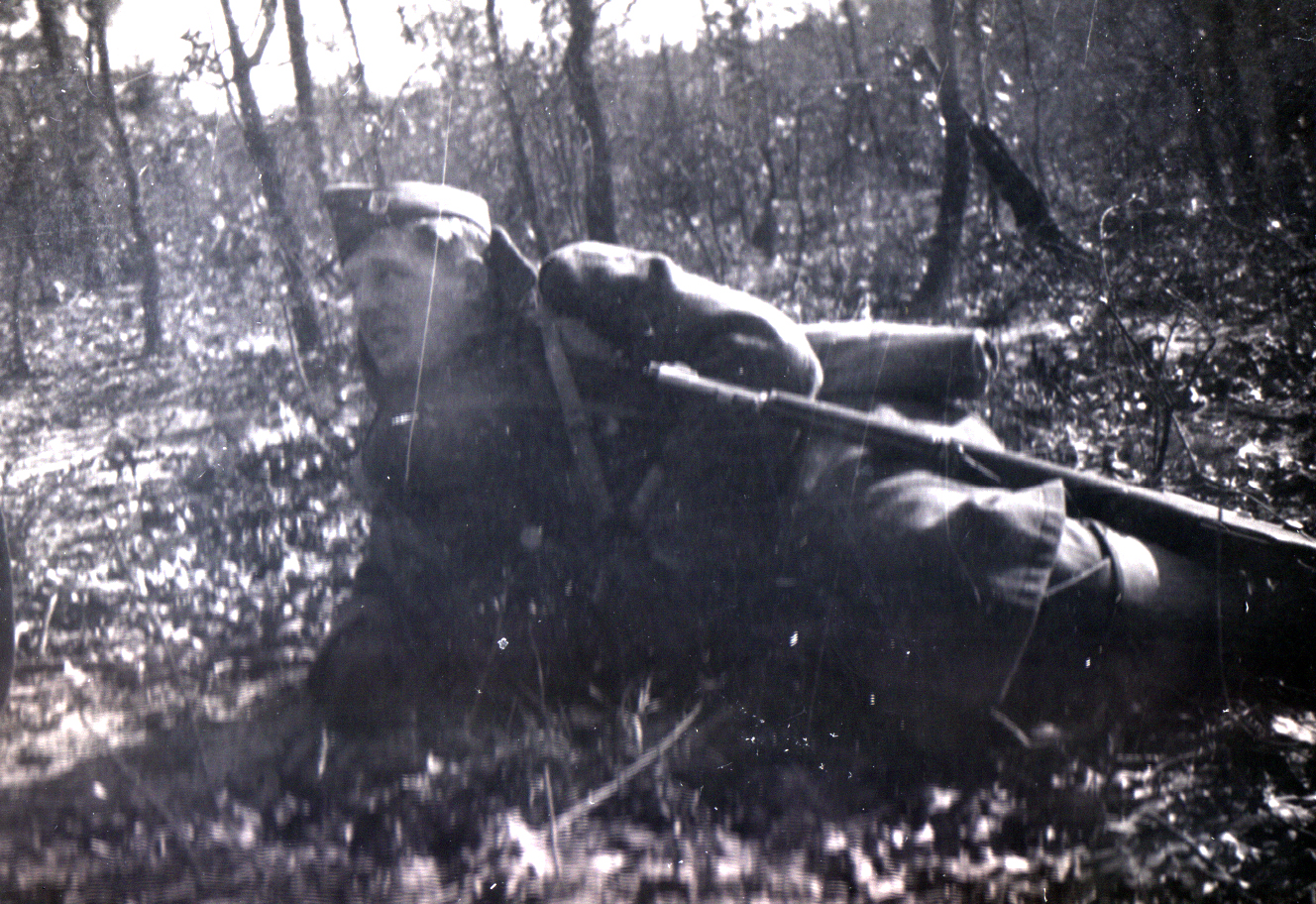 |
| A man crawling through the underbrush most likely during tactical maneuvers. |
 |
| Mel's tentmate |

 |
| I'm almost positive the seated man in this photo is my grandfather. |
 |
| A lean-to made of a single shelter half. |
 |
| A blazing campfire somewhere in the dark woods. |
 |
| The US Army printed holiday cards to send home to the folks. This is one from Easter of that year. |
Subscribe to:
Posts (Atom)