This is the closest possible thing to an eyewitness account of the war as my grandpa saw it. This man was born the same year as Mel (1919) and would have been 88 years old at the time of the interview. I tried to search for this veteran so I could correspond with him or possibly meet him, but he died a few months later. The video this text record was transcribed from has also since been deleted.
Arthur C. Neriani
Enlisted 1940, Honorably discharged 1945
HQ Company, 13th Infantry Regiment, 8th Infantry Division
Interview conducted by Matthew Kwapien for oral veterans history project. Arthur C. Neriani enlisted in the National Guard in December of 1940. Soon after, in February of 1941, the Guard was federalized and he was sent to Camp Blanding, FL for basic training. After basic training he was sent to Officer Candidate School, and then became part of the 8th infantry division in Fort Leavenworth, KS. From there the 8th infantry division was shipped to Northern Ireland to await their orders. Twenty eight days after the D-day invasion, the soldiers were sent to Normandy to replace the 82nd airborne division. Their mission was to travel up the Brittany peninsula, and establish a port for incoming Allied supplies. From there the soldiers travelled into Germany, where they fought in the Battle of Hürtgen Forest, a battle that had 33, 000 casualties, but has been largely overlooked. Neriani describes in great detail what he and the soldiers under his command endured during the very long, cold battle. The 8th infantry division was also responsible for the liberation of the Wobbelin concentration camp, which is just outside of Ludwigslust, Germany. After the fighting in Europe ended, the soldiers were sent back to the United States in order to train for the Battle of Japan, and the Pacific theatre of operations, but the war was declared over before they were sent. Neriani was discharged in Mississippi in late 1945, and he returned to Connecticut where he joined the Avon VFW and was the first commander of the post.
Thursday, December 5, 2013

Wednesday, September 11, 2013
Following the Golden Arrow
Ben Atkinson, an independent filmmaker working with a fledgling producer and composer, is raising money to produce a documentary about the 8th Infantry Division in the European Theater during World War II. Here's a short video about it as well as the link to the project kickstarter website:
http://www.kickstarter.com/projects/schifflifilms/following-the-golden-arrow?ref=card
The 8th ID "The Golden Arrows" are an untold story in the chapters of history. Some Army units (like the 101st and 82nd Airborne) had much better PR than others and so their story made it into the history books while others with no less interesting stories did not. Personally, being the grandson of a silent veteran who served in this division, I hope the project will give me a better understanding of what he experienced during a time America will never forget.
http://www.kickstarter.com/projects/schifflifilms/following-the-golden-arrow?ref=card
The 8th ID "The Golden Arrows" are an untold story in the chapters of history. Some Army units (like the 101st and 82nd Airborne) had much better PR than others and so their story made it into the history books while others with no less interesting stories did not. Personally, being the grandson of a silent veteran who served in this division, I hope the project will give me a better understanding of what he experienced during a time America will never forget.
Thursday, June 6, 2013
Reading WW2 Weekend
 |
Here's lookin' at you, Grandpa! |
Go here for more info if you'd like to attend this event in the future: Mid-Atlantic Air Museum
This is one of the best videos from last year's air show:
Monday, June 3, 2013
More interesting photos from basic training
There are over a hundred undeveloped slides in a small cardboard box
among Mel's possessions; I have digitized all of them. While none of these are dated, they are most likely 1941-'42, as
he was in the desert by '43. None of the people in the slides are
identifiable, but they are certainly his buddies. I will post some of
the interesting ones a few at a time from now on...
The incredible thing is not what is going on in these pictures, as every soldier in boot camp did mundane things like this every day. But rather it is the fact that my grandfather was able to capture these images, and give us an impression of what Army camp life was like during the 1940's.
 | ||||
Guarding a drinking water reservoir. Guard duty was a tedious but necessary part of being a soldier, as base security was maintained by the men who lived in it. It would be part of routine "fatigue detail," what the officers liked to call these duties because they made one fatigued. A chore to some, a happy and easy job for others, being posted as a sentry also taught the men discipline and how to be vigilant.
|


 |
Some men looking at an odd anachronism within a WWII camp...a Civil War artillery piece. This was identified by a reenactor friend as a '3-inch ordnance rifle'. The only place where this would conceivably be is at Fort Jackson, South Carolina, which would make the year 1941. |
 |
| The soldiers ate their meals with soup or rice served from old tin milk cans. |
 | ||
| A friend on 'KP duty' washing his mess kit after a meal. As every Boy Scout knows, one bucket is for hot sterilization with soap and the other bucket is for a cold rinse. |
 |
It was clear that everyone knew he had a camera, as some of these pictures appear to be staged.
"R&R" time in camp for some consisted of playing team sports, like basketball, rugby and baseball. I find the action poses entertaining. |
 |
| There was also some cheap forms of entertainment in camp. The 8th Division had its own movie theater where you could go to watch newsreels or some popular "flicks," usually by request. This was when a day at the movies cost you a couple of nickels. |
 |
| A picture of an unidentified man shaving outside his company tent. |
 |
| Eating watermelon. Now why were soldiers eating watermelon, and why did Mel take a picture?
Summers in South Carolina tend to be hot and humid, and veteran Arthur Neriani of the 13th Infantry Regiment, 8th Division, attests that one day after a long march, the men came across a fruit merchant who wandered into camp and sold them fresh watermelons, much to the pleasure of the hot and tired men. While this photo has very little significance, I find it interesting that this distant memory of an old GI was confirmed with my grandfather's photographs.
|
The incredible thing is not what is going on in these pictures, as every soldier in boot camp did mundane things like this every day. But rather it is the fact that my grandfather was able to capture these images, and give us an impression of what Army camp life was like during the 1940's.
Saturday, June 1, 2013
1942 - Mel promoted to Sergeant, Camp Forrest Tennessee Maneuvers
 |
| Mel earned his Sergeant stripes on August 7, 1942. |
 |
| Some time that year he visited home and got another photo looking sharp in his dress uniform. Interestingly, he's still wearing the brown leather 'garrison belt' that was outdated by this time (No longer required per regulations after 1941) This, and the bare trees behind him, leads me to believe this photo was taken sometime in early April or late March of '42. |
 |
| Aunt Marilyn is trying on his Class A visor cap. |
"1942 – The 8th Division was ordered to patrol the Atlantic coast. For six weeks during the winter of 1942, units of the division ranged along the eastern shores of the country from North Carolina to the Florida Keys. The 8th became a Motorized Division.March 1942 – The 8th Division returned to Fort Jackson late in March to resume training.Sep 1942 – There was a motor march to the location of the Tennessee Maneuvers. Two more months of war games further hardened the troops of the 8th. Then, after a brief stay in tents at Camp Forrest, Tennessee, the Division set out for its new station, Fort Leonard Wood, Missouri.December 1942 - March 1943 – There was a period of comparative calm."
The following slides were most likely taken at camp Forrest., as they are dated 1942 and show them camping in tents in the woods during the winter. He doesn't have many pictures of this period, probably due to facing unfavorable weather and the fact that many of the operations during these war games were classified. These wilderness survival and combat exercises, though meant to condition the men for living and fighting through the forests of Central Europe, had ill prepared them for the horrific ordeal they would face during winter in the Hurtgenwald and the Ardennes as part of their drive into Germany.
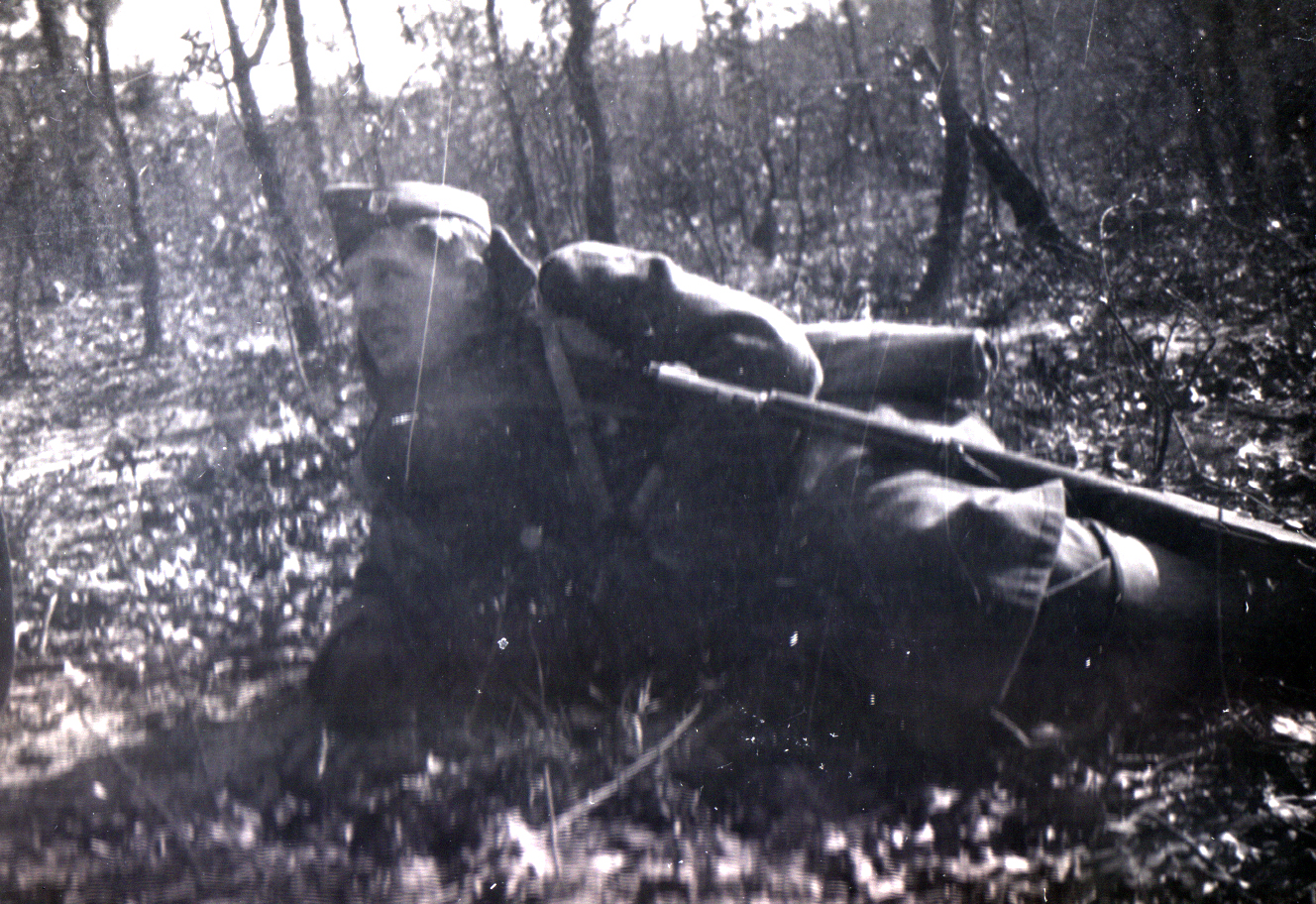 |
| A man crawling through the underbrush most likely during tactical maneuvers. |
 |
| Mel's tentmate |

 |
| I'm almost positive the seated man in this photo is my grandfather. |
 |
| A lean-to made of a single shelter half. |
 |
| A blazing campfire somewhere in the dark woods. |
 |
| The US Army printed holiday cards to send home to the folks. This is one from Easter of that year. |
Monday, March 18, 2013
Complete Timeline for the 8th Division in World War II (with map)
 |
| (Click image to enlarge) |
8th INFANTRY DIVISION IN WORLD WAR II - TIMELINE
OF SIGNIFICANT EVENTS
1 Sep 1941 –
The 8th Division took part in the Carolina Maneuvers.
1942 – The 8th Division was ordered to patrol the
Atlantic coast. For six weeks during the winter of 1942, units of the division ranged along the eastern shores
of the country from North Carolina to the Florida Keys. The 8th
became a Motorized Division.
March 1942 – The 8th Division returned to Fort
Jackson late in March to resume training.
Sep 1942 – There was a motor march to the location of the
Tennessee Maneuvers. Two more
months of war games further hardened the troops of the 8th. Then, after a brief stay in tents at
Camp Forrest, Tennessee, the Division set out for its new station, Fort Leonard
Wood, Missouri.
December 1942 - March 1943 – There was a period of
comparative calm.
March 1943 – The 8th moved to Camp Laguna,
Arizona, for six months of desert training (in preparation for a planned
invasion of North Africa).
August 1943 –
The Division returned to Camp Forrest.
Preparations were begun immediately for an overseas movement.
27 November 1943 – The 8th arrived at the staging
area of Camp Kilmer, New Jersey.
5 December 1943 – The 8th Infantry Division
sailed from New York Harbor.
15 December 1943 – The Division arrived in Belfast, Northern
Ireland for training. Every two
weeks the Division sent seventy-five enlisted men and fifteen officers to the
British 55th Division and received an equal number of United Kingdom
troops for a two-week period. By
living and training amongst their allies, the 8th learned to
coordinate their efforts with the British.
1 Jul 1944 – A convoy of four troop ships and twelve motor
transports carrying the 8th Division steamed out of Belfast Harbor.
4 July 1944 – The Division landed at Utah Beach.
6 July 1944 – The Division assembled in the vicinity of
Monteburg.
7 July 1944 – The 8th Infantry Division entered
combat.
8 July 1944 – The 8th Division jumped off on its
first attack in the Battle of France.
26 July 1944 – The Division crossed the Ay River.
28 July 1944 – Resuming the advance the 8th
Division proceeded rapidly against light resistance until it had taken all
objectives.
1 August 1944 – The Division continued to move southward,
clearing out small pockets of resistance and securing road nets and vital
installations along the route of march.
3 August 1944 – The 8th Division reached St.
James.
4 August 1944 – The Division moved to an assembly area near
Betten, northeast of Rennes. 8 August 1944 the Division pushed through Rennes.
9 August 1944 – The 3rd Battalion was cut off
from the regiment. For three days it withstood almost incessant artillery
bombardment and repeated attempts by the enemy to annihilate it, suffering many
casualties.
13 August 1944 – The 8th Division continued its
mission of holding and defending Rennes.
During this period, it maintained road blocks, cleared rubble and
obstacles from the streets,a nd engaged in extensive patrolling. Although some prisoners were taken, no
contract was made with organized enemy forces.
14 August 1944 – One of the regiments occupied Dinard. A task force, composed mainly of the 3rd
Battalion, 28 Infantry, moved to the Cap Frehel peninsula, farther east in
Brittany, to take over positions held by French Forces of the Interior.
15 August 1944 – The Division, meanwhile, had moved to an
assembly area near Dinan.
17 August 1944 – The remaining elements of the Division
began movement to an assembly area near Brest. There, for three days, operations were confined to
patrolling.
21 August 1944 – The Division closed into its sector and
awaited orders to attack Brest.
29 August 1944 – The enemy in the sector of the 3rd
Battalion, 28th Infantry, called a truce to evacuate wounded. Previously, two companies of the 2nd
Battalion, 28th Infantry, had advanced beyond their adjacent units,
been cut off and captured by the Germans.
After Brest had capitulated, these two companies were freed by men of
their own unit from a German prisoner of war enclosure on the Crozon peninsula,
south of the harbor of Brest, and returned to their unit.
31 August 1944 – The 8th prepared for a
coordinated Corps attack which was to include also the 2nd
Division. A road in the vicinity
of the town of Kergroas was the objective.
8 September 1944 – With an improvement in the supply of
artillery ammunition, the 121st Infantry attacked and seized the
eastern end of the strongly defended Lambzellec ridge. The 121st then advanced
toward the town of Lambzellec, and by noon was fighting in the streets. The 13th Infantry advanced
abreast to positions from which it supported the attack of the 121st.
10 Sep 1944 – Having passed through Lambzellec, the 121st
was confronted with Fort Bouguen.
This was a formidable work of thick walls, twenty to thirty feet in
height, surrounded by a dry moat, twenty feet deep. Such an obstacle could not be assaulted by infantry without
artillery fire.
11 Sep 1944 – Heavy artilelry fire was directed at the wall.
This fire failed to make an appreciable breacha nd the VIII Corps Commander
decided to suspend further operations against that portion of the inner
defenses, and to contain the enemy within Fort Bouguen, while efforts were
renewed farther east. He therefore
directed that elements of the 2nd Infantry Division relieve the 8th
Division in front of the fort. The next day the 13th and 121st
Infantry Regiments withdrew to a temporary assembly area near Plouvien.
14 Sep 1944 – The Division moved into its attack positions.
15 Sep 1944 – After a strong barrage by heavy and light
artillery and chemical mortars, the attack began. In the zone of the 28th Infantry, the 3rd
Battalion led the attack. By 0930
it was approaching the hamlet of St. Eflez. The 3rd Battalion and the 1st following
it were under heavy flanking fire from the south ridge. All officers of Company L became
casualties. Tech Sergeant Charles E. Balance reorganized the companya nd took
command. He was killed by a sniper the next day. In the vicinity of St. Eflez,
resistance grew so fierce that itw as apparent that the main line of enemy
defenses had been reached.
16 Sep 1944 – German counterattacks on both ridges were
repulsed. AT 0700 hrs the attack was renewed under cover of a dense fog, which
was to furnish an effectiev mask for each morning of the Crozon action. By 19
Sep 1944, the Crozon Peninsula was cleared.
26 Sep 1944 – The 8th Division began the long
move from the Crozon peninsula to the grand Duchy of Luxembourg. Foot troops and trucked vehicles made the
journey by rail. By 30 Sep 1944, Motorized elements arrived in convoys near
Ettelbruck, Luxembourg.
9 Oct 1944 – Trainign began with 1, 538 officers and
enlisted men available. They were
armed for the most part with rifles, automatic weapons and several anti-tank
guns. Eight companies of
approximately 200 men each comprised the battalion. Fiev of these were rifle
companies. Training of this unit
was continued, for two hours daily, until October 20th.
7 Oct 1944 – A vehicle bearing Lt. Colonels Frederick J.
Bailey Jr. and john P. Usher of the 28th Infantry, was traveling
well in rear of the front lines when it was flagged down by what appeared to be
a US Army Captain and Sergeant, standing beside a halted American First Army
Jeep. Pulling alongside, and hearing the “captain” talking wildly in German
although he wore an American combat jacket and helmet, the 28th
Infantry officers opened fire and killed the two men.
19 Oct 1944 – A plan was worked out to rotate the
troops. One platoon at a time was
relieved.
3 Nov 1944 – Both Vossenack and Schmidt had been taken, and
a line of departure for the attack upon Hurtgen secured. So difficult was the terrain, however,
that only foot troops could get through to Schmidt. There was no road between
the two captured towns over which armor and Anti-tank guns could move.
7 Nov 1944 – Unable to get armored units through to the foot
troops, the 28th Division was forced to withdraw from Schmidt. At one time the Germans also recaptured
half of Vossenack, but here their counterattack was again driven back.
16 Nov 1944 – The 13th Inf. And the 8th
Reconnaissance Troop began the motor march of the 8th Division to
the V Corps front, and by nightfall they had arrived.
19 Nov 1944 – All elements of the Division had closed into
their positions in the area southeast of Aachen.
20 Nov 1944 – The Division drove across France to Luxembourg
and moved to the Hurtgen Forest.
21 Nov 1944 – The 121st Infantry opened the drive
on Hurtgen. Attacking with three battalions abreast, the Regiment immediately
ran into strong resistance. Enemy
mortar and artillery tree bursts shattered the forested area and hailed
shrapnel down upon infantry units whenever they attempted to advance, antipersonnel
minefield further increased the peril of movement through the dense woods. On
the 24th November the attack of the 121st Infantry
resumed.
25 Nov 1944 – At a conference of V and VII Corps Commanders
it was decided to begin the armored attack on the morning of November 25th. At least three rifle companies were to
advance astride the road during the night so the road could be cleared.
26 Nov 1944 – Enemy pockets in the woods inf ront of the 1st
and 2nd Battalions, 121st Infantry were taken without
opposition. Company F, 121st
Infantry, had advanced to a point approximately 300 yards southwest of
Hurtgen. Here it was met by dense
machine gun fire. Company F held its advanced position during the night, and
resumed the attack with the entire regiment the next morning.
27 Nov 1944 –
The 1st Battalion, 13th Infantry, joined the 2nd
and 3rd Battalions, 121st Infantry in the attack at 0700.
Division Artillery, less the 43rd Field Artillery Battalion, again
fired prearranged concentrations in support of the infantry units. Company C of the 644th Tank
Destroyer Battalion was also in close support. The next day the Division cleared Hurtgen.
29 Nov 1944 – The attack on Kleinhau began. The enemy
defended stubbornly, holding out in cellars and wooded areas even after armored
forces had driven through the town.
During the night, the 1st Battalion, 13th
Infantry, took over the captured town and the high ground. The enxt day men of
the 13th cleared out remaining enemy pockets.
31 Nov 1944 – Elements of the 121st and 28th
continued to push southeast.
Patrols were sent out by both regiments to determine enemy strength
around Brandenburg. Resistance was encountered almost immediately, and orders
were issued to hold present positions until plans for a full scale attack were
completed.
3 December 1944 – The Division cleared Brandenburg.
23 February 1945 – The Division crossed the Roer River.
25 February 1945 – Duren taken.
28 February 1945 – Erft Canal crossed.
7 March 1945 – The 8th reached the Rhone near
Rodenkirchen and maintained positions along the river near Koln.
6 April 1945 – The Division attacked northwest to aid in the
destruction of enemy forces in the Ruhr Pocket.
17 April 1945 – The Division completed its mission.
1 May 1945 – After security duty, the 8th
Division, under operational control of the British Second Armya nd Task Force
Canham, drove across the Elbe River (advancing in Jeeps, canvas trucks and
tanks) capturing 250,000 mostly German prisoners and penetrated to the town of
Schwerin to rendezvous with the Russians.
The 121st Infantry was the first to visit a
concentration camp near Wobbelin, Germany discovered days earlier by a field
surgeon. They witnessed thousands
of dead and dying prisoners. The
13th and 28th Infantry regiments were also taken through
the camp to observe what the Germans did to their own people. It was here that Staff Sergeant
Melville J. Batt took his color photographs of the camp with Kodachrome
film. Possibly the only color
photos known of a concentration camp.
Between May 1 1945 and May 7, 1945 the 8th Division
was readied to be moved to the Pacific Theater of Operations to assist the Navy
and Marine Corps. But the war was
over before they could be sent.
7 May 1945 -
The war in Europe ended and the Germans officially surrendered. Staff Sgt. Batt was honorably
discharged with a Bronze Star medal and Army Commendation.
Sunday, March 10, 2013
B.A.R. - Browning Automatic Rifle History
Used from the end of World War One until the outbreak of the Vietnam War, this 19-pound monster ruled the field of automatics for over fifty years. This is also the weapon that Grandpa carried in service. These were issued to Staff Sergeants in WWII. I bet that anyone who didn't get this piece, wanted one. This rifle and the M-1 Thompson (the "Tommygun") also featured prominently in gangster movies of the 1930's and '40s. They were very popular guns.

(I picked one of these up before and it feels like it's made of solid lead! I still cannot believe my grandfather carried this when he was 25 or 26 years old being such a scrawny guy)
Watch a video of the history of this powerful mobile machinegun here:
(I picked one of these up before and it feels like it's made of solid lead! I still cannot believe my grandfather carried this when he was 25 or 26 years old being such a scrawny guy)
Watch a video of the history of this powerful mobile machinegun here:
Subscribe to:
Posts (Atom)